| IMO | 9334868 |
|---|---|
| Gross tonnage | 69,203 GT |
| Length | 252.0 m |
| Beam | 32.2 m |
| Passenger capacity (max) | 2500 |
| Service speed | 22.5 knots |
| Builder | Meyer Werft |
| Hull number | S.660 |
| Launched | 2009 |
| Maiden voyage | 2009 |
| Class | Sphinx-class cruise ship |
| Operator | AIDA Cruises |
| Status | Active |
Overview
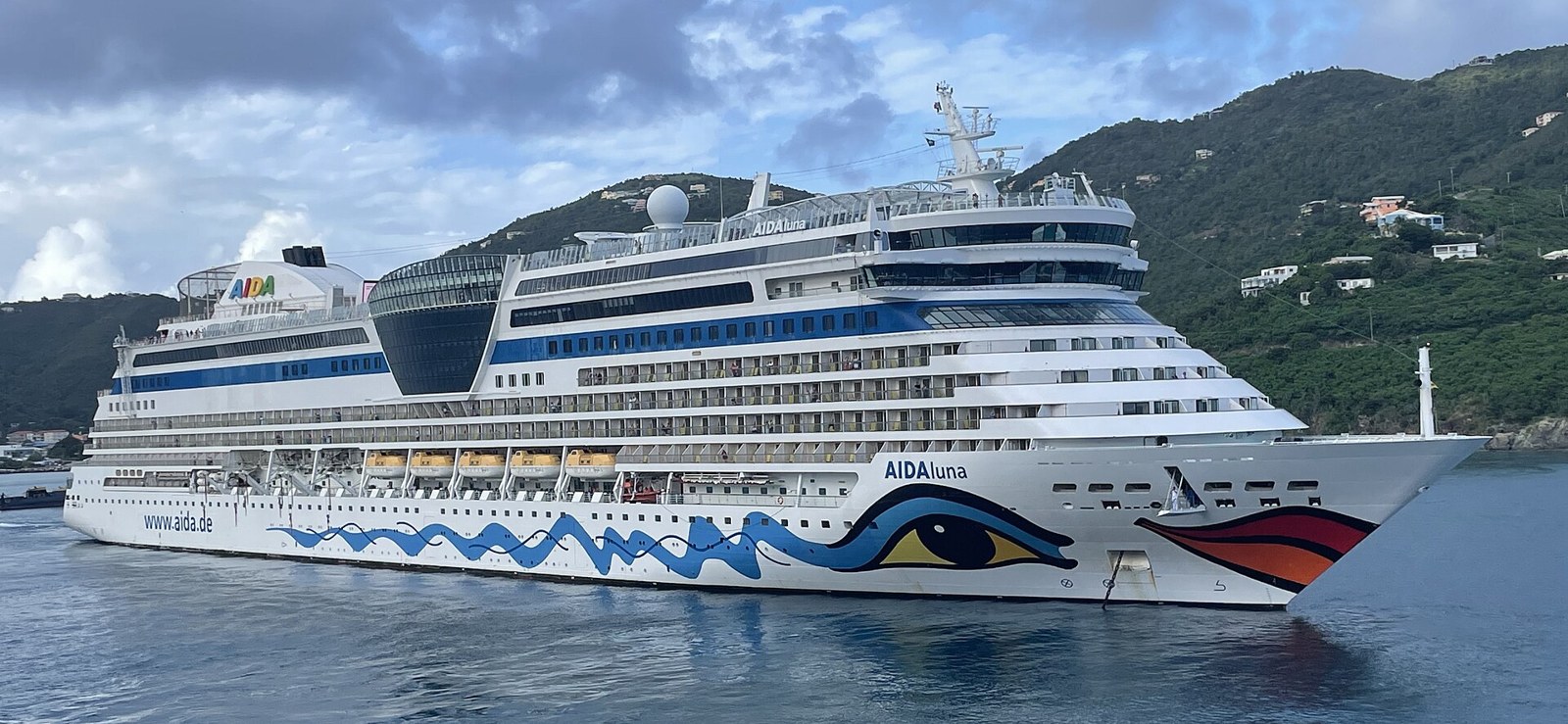
AIDAluna is a Sphinx-class cruise ship built by Meyer Werft at Papenburg, Germany, for AIDA Cruises, the German-market brand of the Carnival group. Delivered in March 2009, she was the third ship of the Sphinx class, following AIDAdiva (2007) and AIDAbella (2008), and she helped establish the design that carried AIDA's expansion through the following decade.
At 69,203 GT she was, with her sisters, among the largest ships yet built for the German cruise market, yet the Sphinx design was conceived around AIDA's informal "club ship" idea rather than around sheer scale: open deck space, buffet-led dining, a theatre merged with the atrium, and a ship intended to feel like a resort rather than a liner. AIDAluna added one notable first of her own — the first poolside theatre screen in the AIDA fleet.
Key specifications
The dataset gives AIDAluna at 69,203 GT, 252.0 metres in length and 32.2 metres in beam, with a maximum capacity of 2,500 passengers and a service speed of 22.5 knots. Wikipedia's figures align closely: 251.89 metres in length, 13 decks, four Caterpillar MaK 9M43C diesel engines producing 36,000 kW in a diesel-electric arrangement, about 2,100 passengers at double occupancy and a crew of about 607. The dataset's 2,500 figure is the maximum-berth number; the 2,100 figure is the normal double-occupancy capacity, and both describe the same ship.
She is registered at Genoa, Italy — a common arrangement for the AIDA fleet, whose ships are owned within the group's Italian Costa structure while being marketed, crewed and operated as an emphatically German product, with German as the onboard language.
Design and construction
AIDAluna was built by Meyer Werft at Papenburg as hull S.660, at a reported cost of €315 million. The Sphinx class was a bespoke design for AIDA — a significant point, because most Carnival-group brands of the period were receiving variations on shared platforms. The Sphinx ships instead carried AIDA's own arrangement: a three-deck-high Theatrium combining atrium and theatre at the heart of the ship, extensive glass, and a pool deck designed to double as an outdoor entertainment venue.
Construction followed Meyer's established method, with the ship assembled in the yard's covered building dock at Papenburg and then conveyed down the River Ems to the North Sea. She was launched in 2009 and delivered to AIDA on 16 March 2009, beginning her maiden voyage six days later.
Naming, launch and maiden voyage
Her name follows the AIDA pattern of short, evocative names prefixed with the brand name — Luna, the moon, sitting naturally alongside sisters such as Diva, Bella, Blu, Sol, Mar and Stella. Unlike her immediate predecessors, whose names were in one case chosen by public competition, AIDAluna's naming is not recorded as a competition result in the sources consulted.
Her maiden voyage began on 22 March 2009 from Hamburg, a 14-night repositioning cruise to Palma de Mallorca calling at ports in France, Spain, Portugal and Morocco. The formal christening, however, took place after the maiden voyage had begun its work: on 4 April 2009 at Palma, the German model and actress Franziska Knuppe christened the ship. Knuppe later also became godmother to another AIDA fleet member, AIDAmira.
Career by operator
AIDAluna has spent her entire career with a single operator. The dataset's operator history also lists Costa Cruises; that reflects the ship's ownership and registry within the group's Costa Crociere structure rather than a period of service marketed by Costa, and she has never sailed as a Costa ship.
| Name | Operator | Years |
|---|---|---|
| AIDAluna | AIDA Cruises | 2009–present |
Her early deployment set the pattern for the class: a first summer season in the Baltic in 2009, followed by a winter season in the Canary Islands. In the years since she has worked the standard AIDA rotation of northern European, Mediterranean, Canary Islands and Caribbean seasons typical of the Sphinx-class fleet, without change of name, flag or operator — a notably settled career by the standards of this directory.
Onboard character
The Sphinx class defined AIDA's onboard character for a generation, and AIDAluna is a representative example. The centrepiece is the Theatrium: a glass-walled, multi-deck space amidships that is atrium by day and theatre by night, putting entertainment in the middle of the ship's circulation rather than in a separate show lounge at the bow.
Her own contribution to the evolution of the class was the 8-by-4.5-metre poolside theatre screen — an outdoor LED screen by the main pool, a first for AIDA, which allowed the pool deck to function as an open-air cinema and show venue. The class also popularised AIDA's dining arrangement of multiple included buffet restaurants supplemented by a small number of extra-charge speciality venues, and facilities such as a 4D cinema and a bicycle station for shore excursions were part of the Sphinx-class formula. The overall effect was deliberately informal: no dress codes, no set dining, and a ship designed for German-speaking families and couples rather than for traditional cruising ceremony.
Major refits and incidents
No major casualty, fire or grounding is recorded against AIDAluna in the sources consulted for this guide; her career has been operationally uneventful in the public record. Like all ships of her generation she has passed through periodic dry-dockings for technical maintenance and hotel refurbishment, though the sources used here do not document a single transformative refit comparable to the rebuilds seen elsewhere in this batch.
One fleet-wide episode did affect her era: the Sphinx ships were early subjects of Carnival-group environmental retrofits, and AIDA's ships of this period were among those fitted for liquefied natural gas use while in port and other emissions measures across the fleet — a programme described at company level rather than as a single dated refit for this hull.
Sister ships and class
AIDAluna is the third of the seven-ship Sphinx class built by Meyer Werft for AIDA between 2007 and 2013. Her sisters, in order, are AIDAdiva, AIDAbella, AIDAblu, AIDAsol, AIDAmar and AIDAstella. The later ships of the class, from AIDAblu onwards, were built to a slightly enlarged version of the design at 71,304 GT, sometimes separated out as the Icarus sub-class; AIDAluna belongs to the original, 69,203 GT group of three and is described in class histories as the last ship of the original Sphinx design.
Fate and where she is now
The dataset records her status as active, and she remains in service with AIDA Cruises under her original name — a ship in mid-career, neither preserved nor transferred, continuing the Sphinx-class programme that her delivery helped to establish in 2009.
Sources: https://en.wikipedia.org/wiki/List_of_cruise_ships; https://en.wikipedia.org/wiki/AIDAluna